

Not buffalo, bufflehead
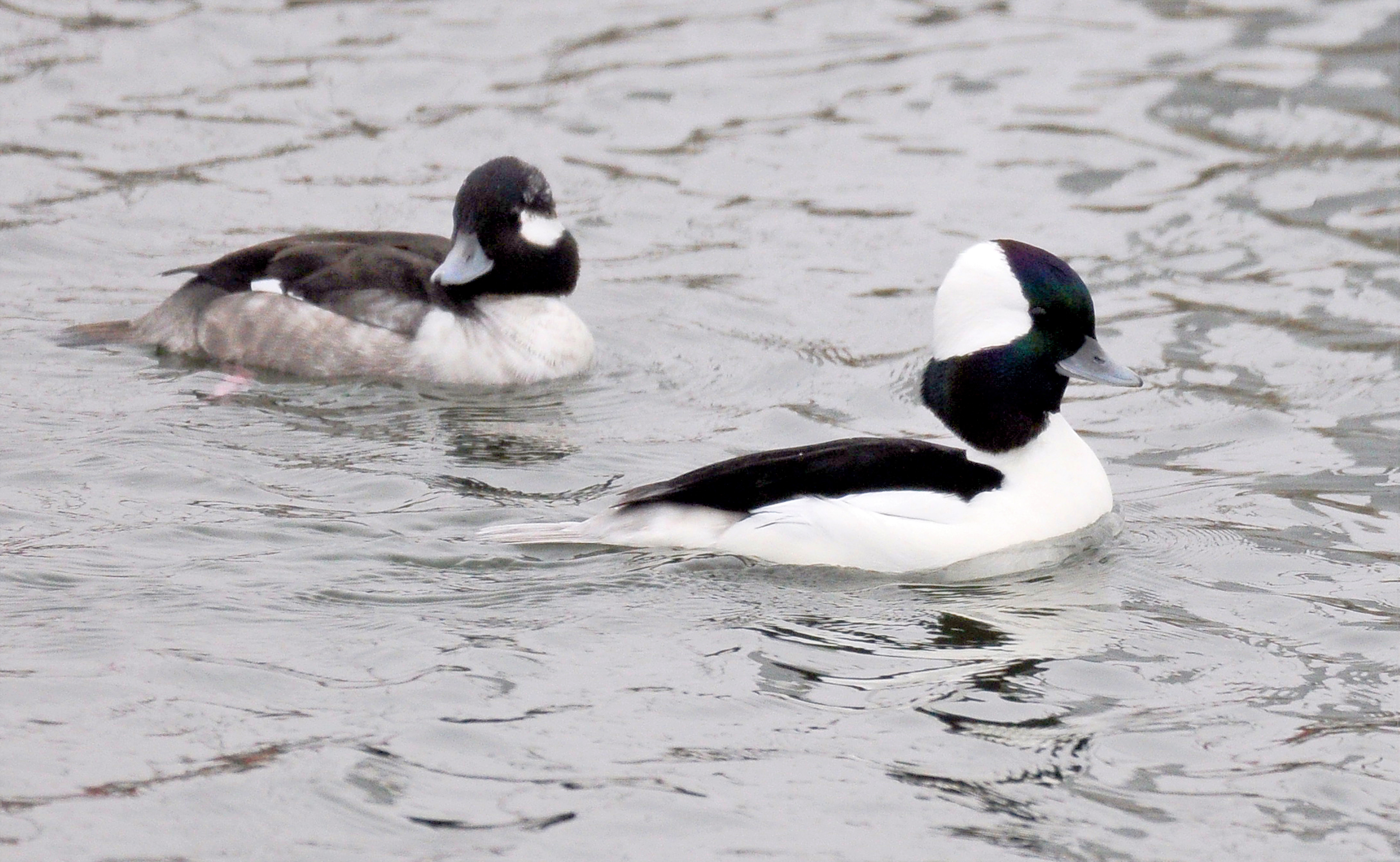
The Wichita Mountains National Wildlife Refuge not only has buffaloes, but also buffleheads during fall and winter.
Don’t you hate writing like that? I do, and I’m sorry you had to read that.
However, the bufflehead is a small waterfowl that is a winter visitor to Oklahoma and is this week’s featured creature.
I always enjoy adding them to my Big Year list, usually every January. And, once you've seen them a couple of times, they become easy to identify, even from a distance.
And it’s not just the refuge where you can see them, but just about all area lakes and many large farm ponds as well.
I don’t think I’ve ever passed the Medicine Park sewage lagoon in winter and not seen at least a pair of buffleheads.
The Cornell Lab of Ornithology reports that by the end of the 19th century, overshooting in the U.S. and Canada had severely reduced the population of buffleheads; however, populations recovered during the 20th century under the protection of the Migratory Birds Convention between both countries.
Appearance
At only about 13 to 16 inches in length, the bufflehead is North America’s smallest diving duck.
Buffleheads are also sexually dimorphic.
The male is black and white, having a mostly white body with a black back and head. The male’s head also has a large white patch that wraps around the back of the head from eye to eye.
Upon close inspection of the male, when the sun shines on his head, one can see a spectacular purple and green iridescence.
Females have light brown bodies with darker brown backs and heads. They have somewhat thin white patches (compared to males) that run from near each eye toward the back of the head.
Male buffleheads really are unmistakable; however, if there is one duck that looks similar, it would be the common goldeneye. The male common goldeneye has a dark green head with a white patch on the face; but the patch is small and lies between the eye and the bill.
Female buffleheads can appear similar to common goldeneye females, but female goldeneyes, while they also have brown heads, lack the white spot on the face.
Range
As I mentioned previously, buffleheads are winter visitors to Oklahoma. Their winter range covers the northern half of Mexico, and most of the southern half of the U.S. They also winter around the Great Lakes, up the Atlantic Coast to Canada, eh, and along the Pacific Coast up through the islands of Alaska. They breed mostly in Canada, eh, but also in portions of the American Northwest.
Habitat
In winter, the buffleheads’ predominant habitat is saltwater; however, many of them remain inland, and as mentioned previously, I see them a lot on ponds and lakes in the colder months.
Diet
Buffleheads are diving birds, which means they dive for their food – and to escape predation. In fact, 50% of their time on the water is spent under the water searching for food. Their diet depends on whether they are in salt or fresh water, and what time of year it is.
In winter on fresh water, according to the Cornell Lab of Ornithology, they eat mostly snails and small clams. The Lab also reports that in fall and winter, plant food becomes more important, chiefly seeds of pondweeds and bulrushes.
Odds & Ends
• According to the Cornell Lab of Ornithology, buffleheads nest almost exclusively in holes excavated by northern flickers, and, occasionally, by pileated woodpeckers.
• The Lab also reports that buffleheads are mostly monogamous, often remaining with the same mate for several years, unlike most ducks.
Editor’s Note: Randy Mitchell is a freelance writer and photographer. He has been an avid birdwatcher, nature enthusiast and photographer for more than 40 years. Reach him at rnw@usa.com.