

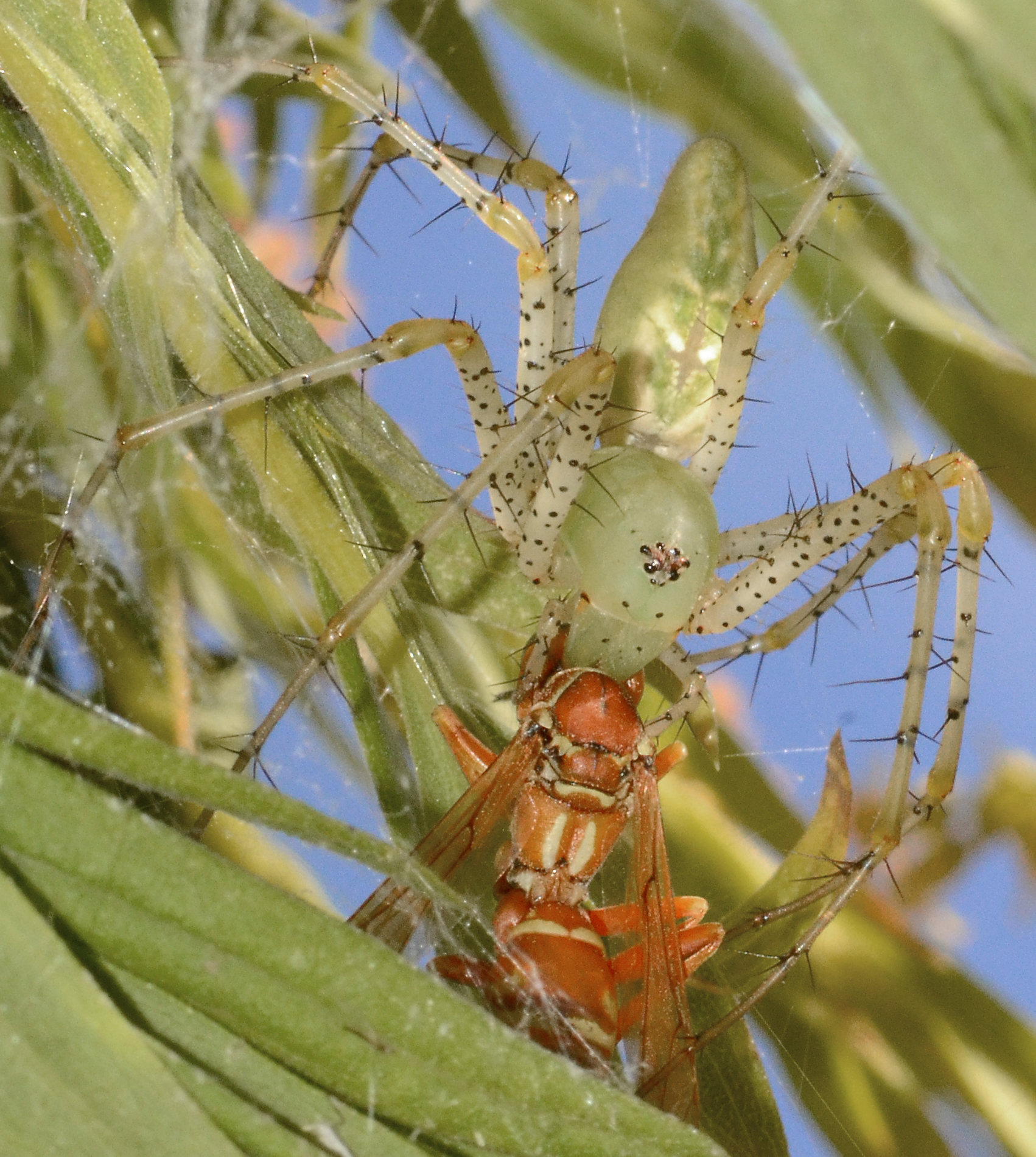
Wasp hunter
This week's featured creature is a wasp hunter.
Actually, the green lynx spider captures and consumes many other insects besides just wasps. It is beloved in certain areas of agriculture as it kills many crop-damaging insects, but it also sometimes consumes beneficial insects, too, such as pollinators.
Honestly, it is a predator of opportunity and pretty much consumes whatever insect it can capture and kill.
But don’t fear this arachnid. Although it has a scary appearance, it is relatively harmless to humans. More on that in odds and ends.
And green lynx spiders are quite common, but not commonly seen. They are pretty good about staying either out of sight or well camouflaged.
Chances are, if you have shrubs around your home, or a garden or tall grass field nearby, then you probably have GLS around as well.
I love the look of these spiders – green overall with long legs covered in black spines.
Additionally, I respect how protective the mother green lynx spider is over here eggs and babies. Notice in one of my photos how a mother GLS is guarding her egg sac. She will do this for a few weeks until the young are born.
On a side note, I created a video concerning the green lynx spider for my Randy’s Natural World YouTube channel. To view it, visit www.youtube.com/watch?v=k-VnGhmKMUM, or search YouTube for Randy’s Natural World. Also, please like and subscribe as well. Subscribing is free. Thank you!
Appearance
Females are often larger than males, ranging in length from a half-an-inch to three-quarters of an inch, not including the legs. Males are usually a half-an-inch in length or slightly shorter.
These spiders are fairly translucent, and the cephalothoraxes appear to have been cast in a green gel. They have incomplete chevron markings on the abdomens.
Legs are translucent and yellowish, and covered with black spines.
There is a red patch between the eyes, and red spots on the body, which vary in number and size between individuals.
Habitat
Most often found in tall grass fields, especially where there are tall, flowering plants. And, as I mentioned before, in shrubs around homes and other buildings such as churches.
Diet
Many species of insects.
Range
Green lynx spiders can be found all over Oklahoma. Also, in most places over the southern half of the United States, from California to North Carolina. Their range also extends well down into Mexico.
Life cycle
Females lay eggs in a silken sac which is attached to vegetation, such as leaves or tall, reedy grasses.
The spiderlings hatch inside the sac after about two weeks, but remain inside until they are fully developed, about a week later.
The mother spider aggressively guards her egg sac until the spiderlings hatch. Once they leave the sac, they immediately begin hunting for tiny insects.
Adults die in the fall, but the young spiderlings survive the winter.
Odds and ends
As I mentioned previously, these spiders are relatively harmless to humans. However, if messed with, they can bite, and the pain would be similar to a wasp or bee sting. Additionally, they can spit venom up to eight to 12 inches. It has been reported that the venom causes eye irritation. It’s probably best to just keep one’s distance from these spiders, and not try to handle them. Especially a mother guarding her egg sac.
The GLS is the largest North American lynx spider.
Editor’s Note: Randy Mitchell is a freelance writer and photographer. He has been an avid birdwatcher, nature enthusiast and photographer for more than 40 years. Reach him at rnw@usa.com.