

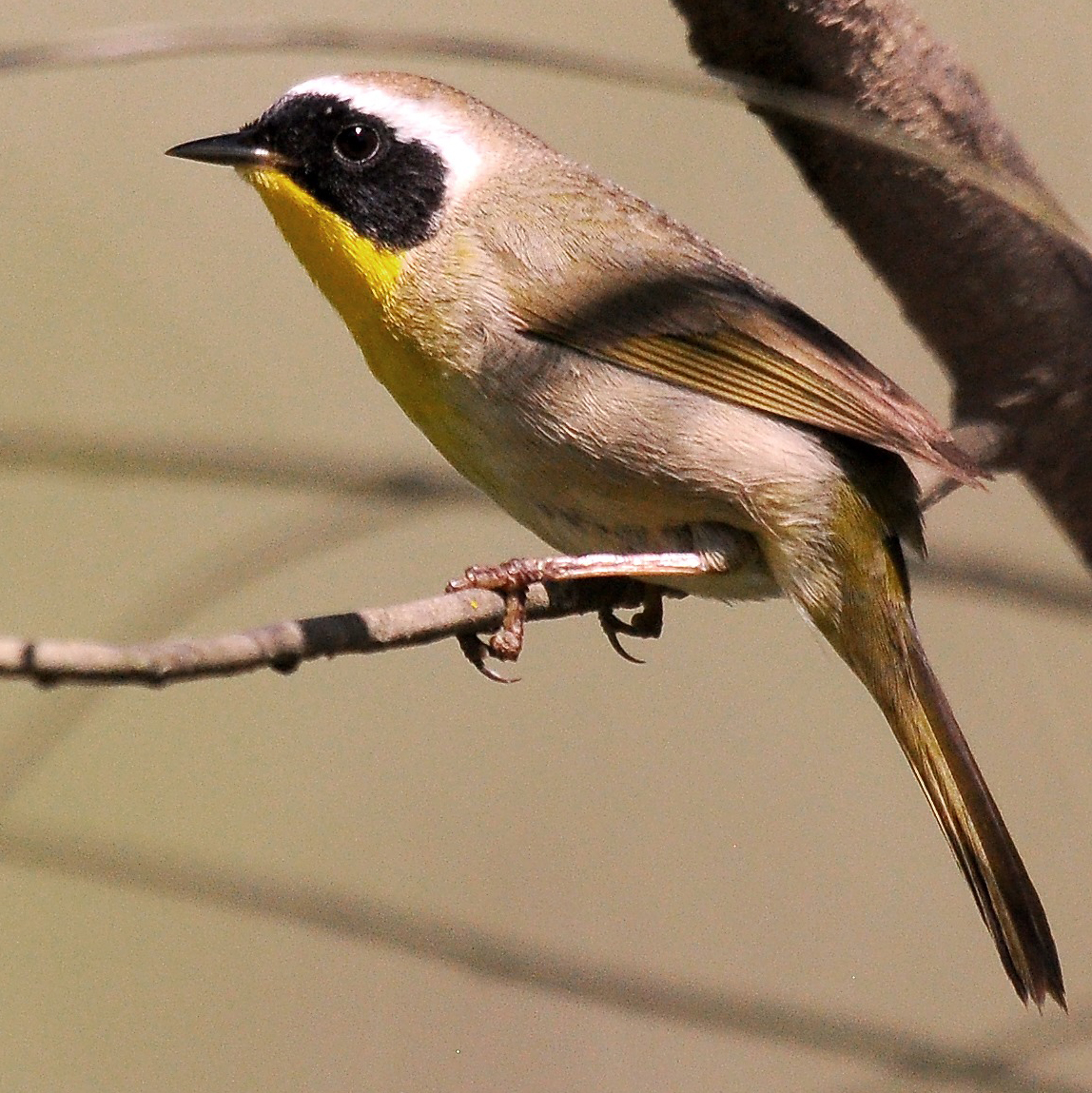
This week’s featured creature is another one of those birds that is called common but isn’t easily seen.
Not only is the common yellowthroat a tiny bird, but also it doesn't much like to venture out into the open, preferring instead to skulk around low to the ground in thick vegetation.
It is also one of the few birds that is a warbler, but does not have “warbler” in its name. In that sense, the common yellowthroat joins the likes of parulas, waterthrushes, redstarts and the ovenbird as being wood warblers without
“warbler” in the names.
Common yellowthroats are summer residents in Oklahoma.
I enjoy seeing them after they return from their winter locations. I also get a kick out of their behavior, sometimes forgetting that they are wood warblers. Typically, warblers search for food in the canopies of large trees such as oaks, but, as mentioned previously, these birds stay fairly low to the ground.
Also, females prefer to stay in even thicker cover than males, so are a little bit harder to find than males.
Additionally, I often hear these birds long before I see them.
Appearance
As mentioned previously, the common yellowthroat is small, about 4.5 to 5 inches in length, with a long tail.
The male is unmistakable with its bright yellow chest and throat, along with its black mask bordered by white (photo).
The female also has a bright yellow chest and throat, but lacks the black and white on the face, having a grayish head instead (photo).
Both male and female are various shades of olive and light brown above.
Habitat
Common yellowthroats inhabit dense vegetation low to the ground, often near water.
Range
Common yellowthroats can be found all over Oklahoma during the summer. Their breeding range covers most of the United States and Canada. They winter in the southern United States from Texas to Florida to Virginia. Also winters in Mexico and the Caribbean Islands.
Diet
Common yellowthroats feed on insects and spiders which they glean from tree branches, shrubs and other vegetation located near the ground.
Insects taken include beetles, ants, flies, wasps, grasshoppers, termites and caterpillars.
Nesting
The Cornell Lab of Ornithology reports that common yellowthroats nest on or near the ground, usually in the vicinity of water. Females lay one to six eggs which are incubated for about 12 days. Nestling period is also about 12 days.
Odds and ends
The Cornell Lab reports that common yellowthroats – like many other songbirds –are often victims of brood parasitism by brown-headed cowbirds. However, yellowthroats may desert a nest if it contains a cowbird egg or if their own eggs have been removed or damaged by a visiting cowbird. They may also build a second or even a third nest on top of a parasitized nest.
I would like to let you know that I have created a Randy’s Natural World channel on YouTube. Please bear with me as I am just starting out, so it will take a little time to build a video library. I think it will be beneficial as you will be able to see more photos, as well as view video footage and listen to bird calls. If interested, please visit my channel, “Randy’s Natural World,” subscribe and click the notification bell, and you will be notified when I upload new videos. Thank you!
(Editor’s Note: Randy Mitchell is a freelance writer and photographer. He has been an avid birdwatcher, nature enthusiast and photographer for more than 40 years. Reach him at rnw@usa.com.)