

Fort Sill National Cemetery hosts Memorial Day ceremony
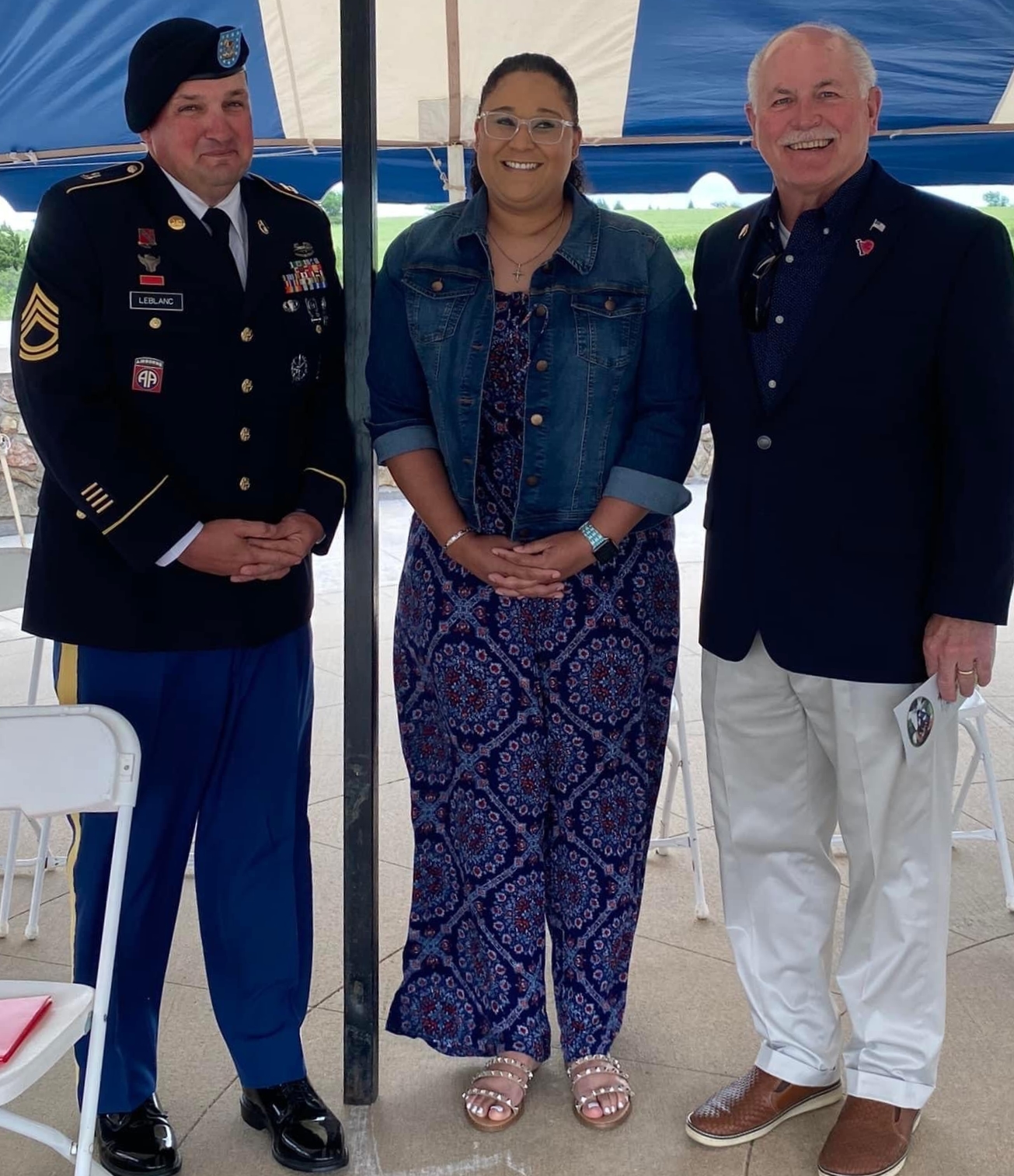
ELGIN – When Sgt. 1st Class Thomas LeBlanc was growing up, he knew what Memorial Day stood for because his grandfather had served in the military.
But LeBlanc said the real meaning of Memorial Day did not hit home for him until he was a young staff sergeant, preparing for the military funeral of Spc. James Butz.
LeBlanc told Butz’s story during a Memorial Day service Monday at Fort Sill National Cemetery near Elgin. It was the first Memorial Day ceremony at the cemetery to be open to the public since 2020, when the COVID-19 pandemic forced officials to limit public gatherings.
Butz was a 21-year-old U.S. Army medic assigned to the 1st Battalion, 505th Parachute Infantry Regiment, 3rd Brigade Combat Team, 82nd Airborne Division out of Fort Bragg, North Carolina. He died Sept. 28, 2011, while serving in Afghanistan.
“He ran into harm’s way to help save a wounded soldier,” LeBlanc said. “Knowing that chaos was raining down around him, Butz was not worried about what could happen to him. All he was worried about was the injured soldier.”
An improvised explosive device went off while Butz was starting to treat the injured person, killing Butz and other soldiers.
When LeBlanc’s unit was notified about Butz’s funeral service and learned that he had belonged to the same brigade, the soldiers knew they had to be squared away at the funeral, LeBlanc said. And when the unit arrived in Butz’s hometown for his funeral, LeBlanc realized the true meaning of Memorial Day.
“Seeing how his death affected his family and friends in his town really hit home,” LeBlanc said. “To this day, I remember Specialist James Butz on this day and the sacrifice he made for me, his family, friends and this nation.”
Internal battles
After telling Butz’s story, Leblanc pivoted to talking about the struggles that service men and women face when they come home.
“When we return home, our real battle or war begins because down range, we are trained to the point of life of death,” he said. “But we are not trained to deal with the silent war that goes on in our heads.”
LeBlanc said when he reported to Fort Sill in April 2015, he met Staff Sgt. Michael Qunitero, who was always smiling and cracking jokes. Qunitero, who served in Iraq and Afghanistan during his military career, showed no sign of having problems in his private life or at work.
But on July 4, 2015, Qunitero’s fellow soldiers received an early-morning phone call telling them to report to the battery. There, they learned that Qunitero had taken his own life because he was struggling at home.
After Quintero’s death, LeBlanc realized that he could not fight his internal battles on his own, he said.
“A few short weeks after his memorial service, I too almost became a number on the wall that has lost their life due to this war,” LeBlanc said.
He said the military is struggling with this problem, either because asking for help shows weakness or because the military does not know how to help anyone who has served on the front lines.
‘They are not forgotten’
LeBlanc said he shared Butz’s and Qunitero’s stories as a reminder that soldiers pay the ultimate price, both on and off the battlefield. He added that some soldiers put themselves in harm’s way while trying to help other service men and women, while others are trying to deal with the silent war that they face every day.
“So today, as we honor the soldiers, airmen, marines and sailors that have made the ultimate sacrifice, let them know that even though they are gone, they are not forgotten,” he said.