

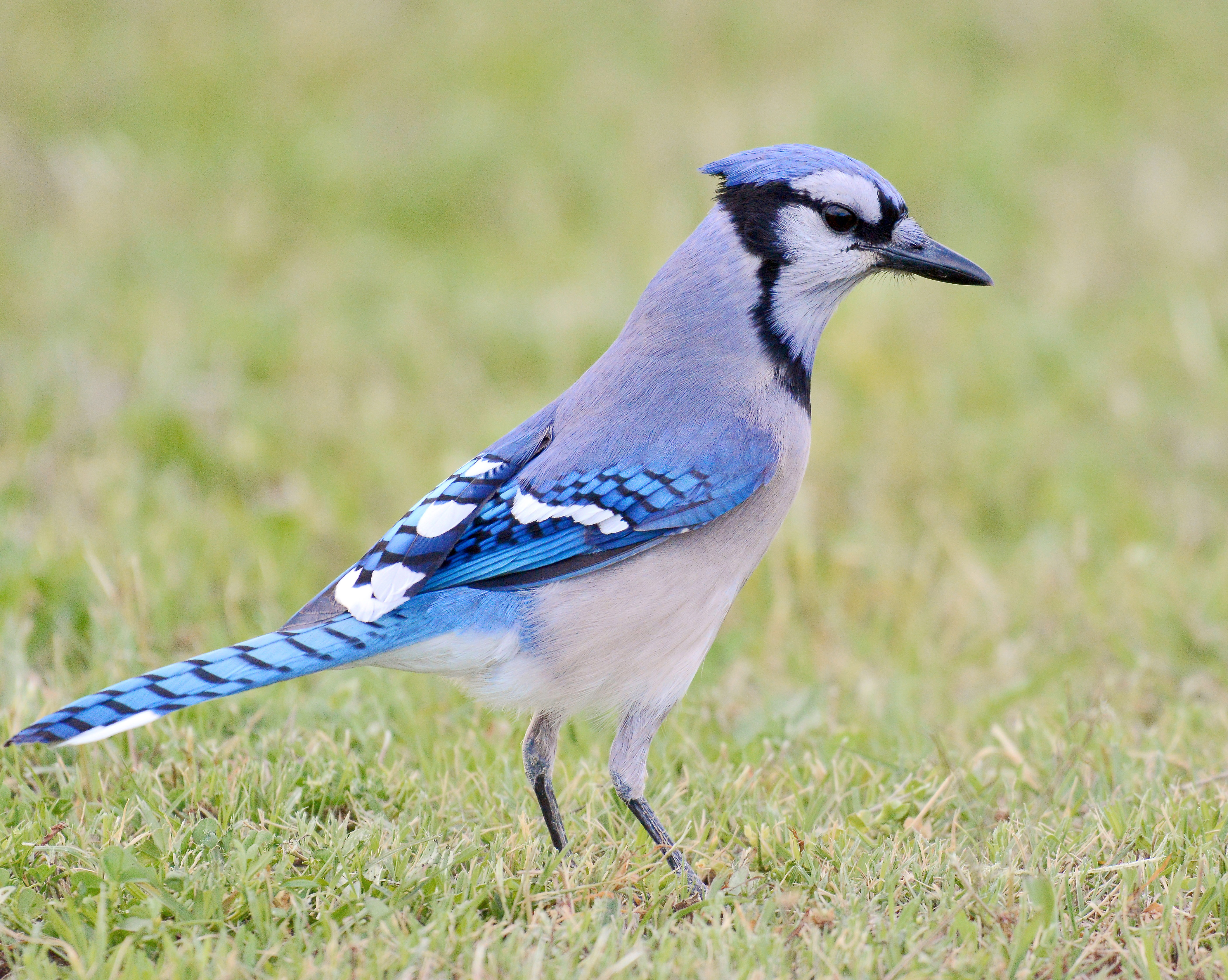
Not the ones from Toronto, eh!
This week’s featured creature is one of the most beautiful birds in the country, yet they’re so common that their beauty may sometimes go unseen.
But honestly, if you feed birds in the winter, then you know how the sight of colorful birds – such as blue jays and cardinals – can brighten up even the most dismal of days.
And blue jays and cardinals on a snowy day – well that’s just icing on the cake.
These birds are a mixture of white, silver, gray and virtually every shade of blue. Some even appear to have lavender coloring.
Blue jays are quite intelligent, form strong family bonds, and have complex social systems.
Unusual jays
Around August each year is when people may see scruffy-looking blue jays that may not be so beautiful. Some birds are even without head feathers.
If you’ve seen a blue jay without head feathers, then you know they resemble vultures. Online searches for “bald blue jay” often soar around August.
When I was a kid, this phenomenon wasn’t fully understood by ornithologists, and still isn’t, as, according to the Cornell Lab of Ornithology, the condition has not been well studied.
This is quite the conundrum for bird experts. Is it caused by feather mites? Molting? The genetics of certain birds? No one knows with absolute certainty.
However, many researchers believe that it is part of a molting process for certain blue jays, cardinals and grackles.
Blue jays and cardinals molt in late summer, and, while the majority of them have a staggered molting process, some lose their neck and head feathers simultaneously.
The Lab reports that these bald birds may be juveniles undergoing their first prebasic molt, which produces the first winter adult plumage. This molt pattern in blue jays is considered normal, and the same thing occurs with enough frequency in northern cardinals to be considered within the normal range, according to the Lab.
Some researchers are convinced its feather mites up to no good. But why just the heads? Why not the bodies as well. Well, they believe it’s because the birds can preen their all of their feathers – except for the ones on their necks and heads.
But there have been studies done with captive jays, which were free of mites, and they still lost neck and head feathers.
There are no hard and fast answers for this phenomenon. But fear not! In most cases, new head feathers grow back in within a few weeks.
And if you see a sort of ragamuffin-looking blue jay at that time of year, those are often either molting or immature birds.
Many young jays look like they have hair, rather than feathers.
Blue jays very good at mimicking some other birds, especially the red-shouldered hawk. Ornithologists aren’t completely sure yet, but believe these calls may provide information to other jays that a hawk is around, or may be used to deceive other species into believing a hawk is present, perhaps to scare them away from a feeder or area in general.
Appearance
Blue jays are slightly larger than robins.
Male and female blue jays are virtually identical. However, males are slightly larger than females. But that is hard to compare unless there is a mated pair beside each other.
Describing the color of blue jays and their patterns would be a waste newspaper space. Almost all blue jays resemble the birds in my photos.
However, according to the Cornell Lab of Ornithology, the black bridle across the face, nape, and throats varies extensively and may help blue jays recognize one another.
Range
Blue jays can be found all over Oklahoma and almost all states east of the Rocky Mountains, and up into most of southern Canada.
And while they are considered an eastern bird, they have been expanding their range to the northwest.
Many people in the Northwest have reported seeing blue jays. Some are seeing them for the first time, but there are some people in the Northwest who grew up where blue jays were plentiful, and now are hearing them for the first time in a long time. Their stories of how hearing blue jays now reminds them of their childhood are quite fascinating, to me anyway.
Habitat
Mostly woodland edges. However, they often inhabit parks, urban and suburban areas, especially where oak trees are present. They love acorns!
Diet
Blue jays eat acorns, seeds, nuts, berries, small fruits and grain. While these items are eaten year-round, insects will make up about 25% of their diets during the breeding season.
They will also eat spiders. Insects taken include beetles, grasshoppers, caterpillars and wasps. Blue jays will not only catch and eat wasps, but they will decimate a wasp nest to get the larvae inside.
At feeders, blue jays are attracted to black-oil sunflower seed, cracked corn, peanuts, peanut hearts, suet, mealworms, millet, fruits and milo.
Nesting
Blue jays are monogamous and pair for life. They typically build a nest each year in March, but won't hesitate to use the abandoned nest of another bird. Usually four to six eggs are laid, and the female incubates them while the male feeds her during this time.
Young are ready to leave the nest between 17 and 21 days. However, young jays remain with and are fed by their parents for up to two months.
Blue jays can live for quite a long time; however, they are most vulnerable in first year of life. They have a high mortality then.
Odds and ends
- The Cornell Lab of Ornithology reports that the pigment in blue jay feathers is melanin, which is actually brown. The blue color is caused by scattering light through modified cells on the surface of the feather barbs.
- The Lab also reports that the oldest know blue jay in the wild was at least 26 years, 11 months old when it was found dead after being caught in fishing gear. It had been banded in 1989 and was found in 2016.
- Blue jays’ fondness for acorns is credited with helping spread oak trees after the last glacial period, according to the Lab.
(Editor’s Note: Randy Mitchell is a freelance writer and photographer. He has been an avid birdwatcher, nature enthusiast and photographer for more than 40 years. Reach him at rnw@usa.com.)