

LUBBOCK, Texas – A heavy cloud of wind-blown dust hung over Lubbock on a recent spring morning, reminding this traveler that the Hub City – a well-earned nickname for this West Texas town – that the weather out here on the plains can turn on a dime.
But it’s just a fact of life out here. And for all it’s open skies, dusty plains and rugged topography, Lubbock is a sparkling jewel of sports, entertainment and things to see and do, as I recently discovered on a visit for Southwest Chronicle.
Battling to keep my hat on as I entered the Buddy Holly Center, when I entered the building, one could sense the late 1950s era rock n’ roll pioneer’s presence. Buddy Holly – born Charles Hardin Holley in 1936 – was a Lubbock native and brought global attention to his hummable, melodic songs, recorded with his backing band, The Crickets.
Did you know Lubbock has two streets named after Buddy Holly & The Crickets? One is Buddy Holly Avenue, and the other is Crickets Avenue. The museum is on Crickets. And inside the museum, visitors can learn all about Holly and his music – sounds that inspired a generation of rock n’ rollers, particularly those British Invasion bands (The Beatles, The Rolling Stones, The Hollies and more) that came in the 1960s, following Holly’s tragic death in an airplane crash near Clear Lake, Iowa, in February 1959.
Upon entering, an 18-minute introductory video is shown, telling visitors all about Holly, from his birth to his final show at Clear Lake’s Surf Ballroom, with Ritchie Valens and J.P. “The Big Bopper” Richardson, both of whom also perished in that snowy crash with Holly and the pilot.
You learn about Holly seeing Elvis Presley when he played in Lubbock and was inspired. He came from a very musical family and Holly’s parents did much to encourage his pursuit of rock n’ roll music.
With The Crickets – crafting “That’ll Be The Day” in drummer Jerry Allison’s bedroom – Holly began playing shows in the region, before finally going to Clovis, New Mexico, to record his first record at Norman Petty’s recording studio.
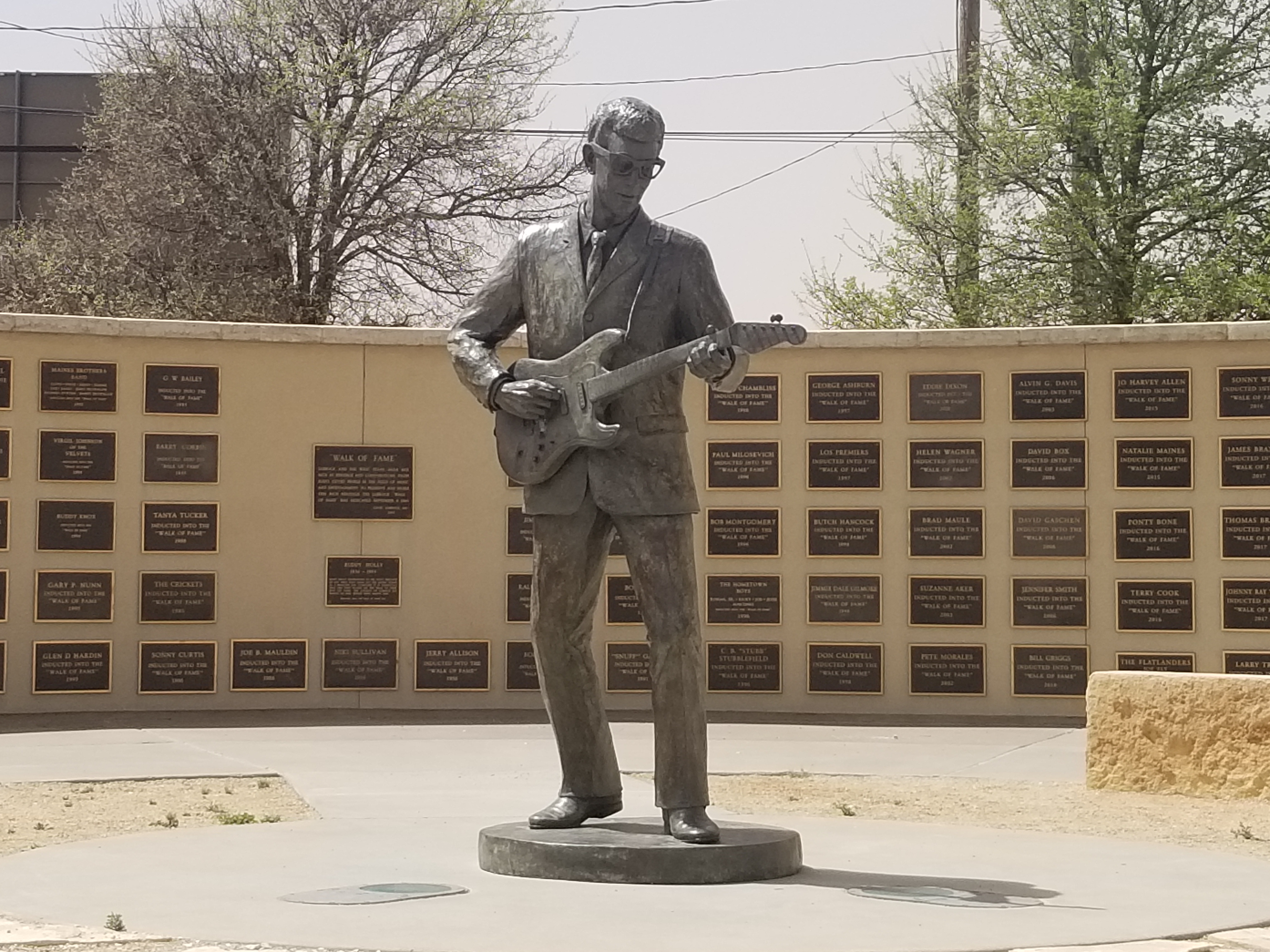
It was all uphill for Holly at that point. He was a musical sensation throughout the U.S. and England. The band even toured England, inspiring a young Paul McCartney. The “cute Beatle” would return the favor decades later by playing a concert in Holly’s honor here in Lubbock, even planting an oak tree at the site of the Buddy Holly statue across the street from the museum.
A portion of the museum features a recreation of a portion of Holly’s Lubbock home and bedroom, shared by his new bride Maria Elena Santiago. Holly was so smitten by Maria Elena that he asked her to marry him on their first date – and she accepted.
Next to the museum is drummer Jerry Allison’s parents’ house, moved from its original location some blocks away. It has been carefully redone to appear as it did in the late ’50s when Jerry lived there and had his drum kit in his bedroom where “That’ll Be The Day” was first crafted.
Carla Hopkins and Richard Kemp were two retirees from Seattle who are big rock n’ roll fans and said that the Buddy Holly Center was on their checklist of places to see.
“I was only a kid when Buddy Holly died,” Hopkins said, “But it was a time I always remembered, and his music made a big impact on me. I still love it.”
For more information go to www.buddyhollycenter.org.
NATIONAL RANCHING HERITAGE MUSEUM
At the National Ranching Heritage Museum, Kathleen O’Brien of Spokane, Washington, and Berry Reyburn of Eagle, Idaho, were exploring the many ranch-related structures on the 19-acre property across the highway from Texas Tech University’s football stadium.
“We both love history,” O’Brien said, as she and Reyburn checked out the steam locomotive near the 6666 Ranch barn. “It was recommended to me by my brother and sister-in-law, here in Lubbock.”
Reyburn said he was amazed to see all these ranch structures brought here – or recreated here – from ranches across Texas and nearby states.
“You definitely need to see it,” O’Brien said of the museum. “It is terrific.”
The Old Block Drift Fence ran 80 miles across New Mexico and was noted in Guy Crandall’s book I Rode A Horse Wild and Free. A sample of the drift fence is on display, as are many samples of barbed wire, that fenced in the once-open range of this region of the South Plains.
Sue Jones, the communications coordinator for the museum told Southwest Chronicle that the museum had just held its annual Ranch Day, where thousands of visitors show up and enjoy all the museum has to offer from square dancing to a snake oil magic show.
“We have approximately 60,000 visitors in a normal year,” Jones said. “And over 4,000 were here last Saturday for Ranch Day.”
Jones noted that the Ranching Center also features many Native American artifacts and items, many of which are currently not on display – and for good reason.
“We have the largest collection of Comanche artifacts outside of the Smithsonian,” Jones said, adding that much of it is fragile and kept in a climate-controlled room to prevent further deterioration.
“We have to be careful about them,” Jones said of the Comanche artifacts.
She was proud to note of the new, enormous windmill that was erected on the museum’s property.
“To tell that story (of American ranching history) is our purpose,” Jones said. “The history of ranching and ranching today.”
School groups visit often, she added. And one of the interesting stories involved the small gravestones displayed on the property.
But, more broadly, what a “ranch” is is something not everyone understands, who visits the ranching museum.
Currently, there is a process underway to develop a $10 million Ranch Life Learning Center that will further explain what ranches were in the past and what they are today, Jones said.
“It’s important to tell that story,” Jones said.
For more information go to www.ranchingheritage.org.
TRAVELERS ARE IN HIGH COTTON AT COTTON COURT HOTEL
When you enter the Cotton Court Hotel in downtown Lubbock, you soon realize you are in for a terrific treat in Texan hospitality and comfort, all while offering a memorable and authentic lodging environment.
This 165-room boutique hotel, located on Broadway, is not far from Texas Tech University and the Depot District entertainment area. The rooms are very comfortable and inviting. Cotton Court, it should be noted, is part of the Valencia Hotel Group.
The hallways feature cotton boll patterns reflecting Lubbock’s long history as a cotton-producing center.
While at Cotton Court’s adjacent Midnight Shift Restaurant and Bar (“Midnight Shift” was a hit by Lubbock native Buddy Holly), the friendly and knowledgeable servers and bar staff make the experience all-the-more memorable.
While enjoying a cocktail at the bar, Big Spring, Texas-based cotton farmer Brandon Iden, was enjoying a drink himself and the cordial environs within Midnight Shift.
Iden often travels from Big Spring to Lubbock, and he told Southwest Chronicle he always enjoys his stays at Cotton Court.
For more information go to www.cottoncourthotel.com.
CAST IRON GRILL
One of the most popular restaurants in Lubbock is also downtown, next to the Buddy Holly Museum. It is the Cast Iron Grill – and it is as good as everyone says it is.
The servers are friendly and quick to take your order and serve you your meal. I settled on the chicken-fried steak, covered in green chile gravy, with a side of pinto beans and fried okra and washed down with an ice-cold Coca-Cola. And for this Okie, it was as yummy as it sounds.
For dessert, my companion and I had the eatery’s “chess pie,” a decadent treat of sugar, eggs and good-old fashioned down-home ingredients that is simply rich and delicious. I felt as if I was in an episode of Food Network’s Diners, Drive-Ins and Dives.
For more information go to www.castirongrilllubbock.com.
FOUR SIXES – 6666 - RANCH
And if you are traveling to Lubbock, via Highway 82, through Seymour, Texas, south of Wichita Falls, you will drive past the famous 6666 (Four Sixes) Ranch, which was originally founded by Samuel “Burk” Burnett, of whom the town of Burkburnett, Texas is named – a name suggested to the postmaster by Burnett’s hunting buddy, then-President Theodore Roosevelt.
The Four Sixes has gained notoriety in recent months due to its prominent role in the Kevin Costner-led modern Western Yellowstone and its spin-off with Tim McGraw and Faith Hill titled 1883. It’s a sprawling ranch, known for its horses and cattle and its remote location in West Texas.
The 6666 Ranch is now owned by the creator and screenwriter of Yellowstone and 1883, Taylor Sheridan, who was recently awarded a Wrangler award at the Western Heritage Awards at the National Cowboy & Western Heritage Museum in Oklahoma City in early April. It was his fifth such award.
As Lawton native and Yellowstone actor Rudy Ramos said in late 2021, “it doesn’t get any better” than working with Sheridan, Costner and the crew on Yellowstone, where he plays the role of Native father Felix Long.
While 6666 Ranch is currently not allowing tours, the stallion breeding operation is open for those looking to inspect the stallions currently available.
Cindy Jouett, executive assistant to 6666 Ranch’s horse division, said the 6666 Supply House, in the neighboring town of Guthrie, is open to the public and “sells branded products” of the ranch, although the store largely eschews selling anything related to Sheridan’s TV programs.
For more information go to www.6666ranch.com.