

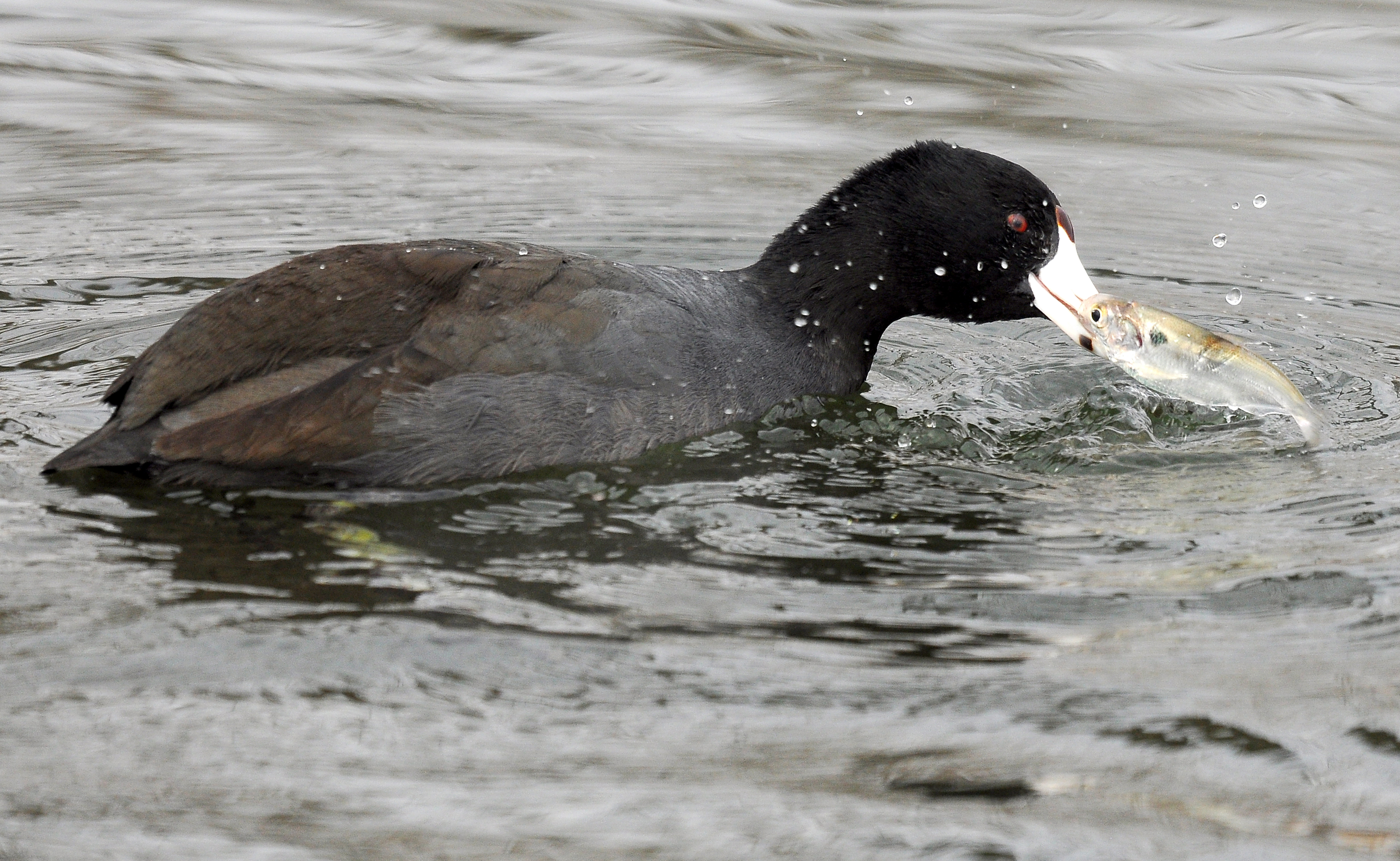
The peculiar American coot is a somewhat common permanent resident in Oklahoma, and is this week’s featured creature.
The bird is in the Rallidae family. However, whereas most birds in that family — rails, moorhens and gallinules — have long, thin toes for walking atop and between aquatic vegetation, coots have odd-looking, lobed toes.
As American coots spend most of their time in the water, these lobed toes help propel them along. The lobes also help these birds dive, both for food and to escape predators.
I heard the phrase “old coot” long before I knew there was a bird named coot. Merriam-Webster’s Dictionary lists — along with the bird — a coot as “a harmless, simple person.” The definition included this example in a sentence: “Don’t mind him — he’s just a crazy old coot.”
I sense people will be saying that about me in the near future!
Some refer to these birds as mud hens, but when I first observed these birds as a child, I jokingly referred to them as water chickens. Not only do they resemble chickens, but they even sound a lot like chickens. If you’re ever in the presence of a flock, you’ll know what I mean.
In the birding world, coots are kind of a dime a dozen. So, it’s easy to spot a flock of coots and then write them off as just a bunch of coots. I often did this as a young bird watcher.
However, I learned over time that a closer look can sometimes pay off as other, more rare birds — often a single bird — will hang out with a flock of coots.
Although they are mostly aquatic birds, coots will also feed on land but will usually remain close to water.
And whether walking or swimming along, coots move their head back and forth, like chickens and many other birds.
Appearance
At 15 to 17 inches in length, the American coot is smaller than a crow but a little plumper.
Coots appear all black, but they are dark gray overall, with black necks, heads and faces. They have distinctive white bills and frontal shields between vivid red eyes.
Habitat
Coots are aquatic birds for sure and inhabit inland bodies of water, such as lakes, large ponds and marshes.
Range
The American coot can be found all over Oklahoma year round. However, they are much more abundant in winter. Their permanent range lies within about 15 states from the Mississippi River through Colorado and up to Washington. Also, down into Mexico. Its breeding range extends well up into Canada, eh!
Diet
Coots feed mostly on aquatic vegetation. But they also eat some terrestrial vegetation, grains, aquatic invertebrates and even some vertebrates, such as fish and tadpoles.
Coots are prey for many other animals, especially eagles, falcons, owls and hawks.
Nesting
Coots build floating nests over water from dead vegetation, which is secured in the nest to living vegetation.
The female lays eight to 12 eggs, which are incubated for nearly a month, according to the Cornell Lab of Ornithology. Young are born alert and are ready to leave the nest with parents after six hours.
Odds and ends
• As mentioned previously, the lobes on coots’ feet help propel them through water. These lobes — or flaps, if you will — fall back as the bird’s toes are moving forward, but spread out while the foot is being pushed back.
• American coots can be quite aggressive — toward their own species and other birds as well, particularly ducks. On their nesting grounds, coots will sometimes destroy the nearby nests of ducks and some other birds. However, during the winter, they are much more peaceful.
• Although coots are good at swimming and diving, they are not great at flying. They are somewhat clumsy in the air, and must run atop the water’s surface — or on the ground — for quite some distance before takeoff.
Editor’s Note: Randy Mitchell is a freelance writer and photographer. He has been an avid birdwatcher, nature enthusiast and photographer for more than 40 years. Reach him at rnw@usa.com.