

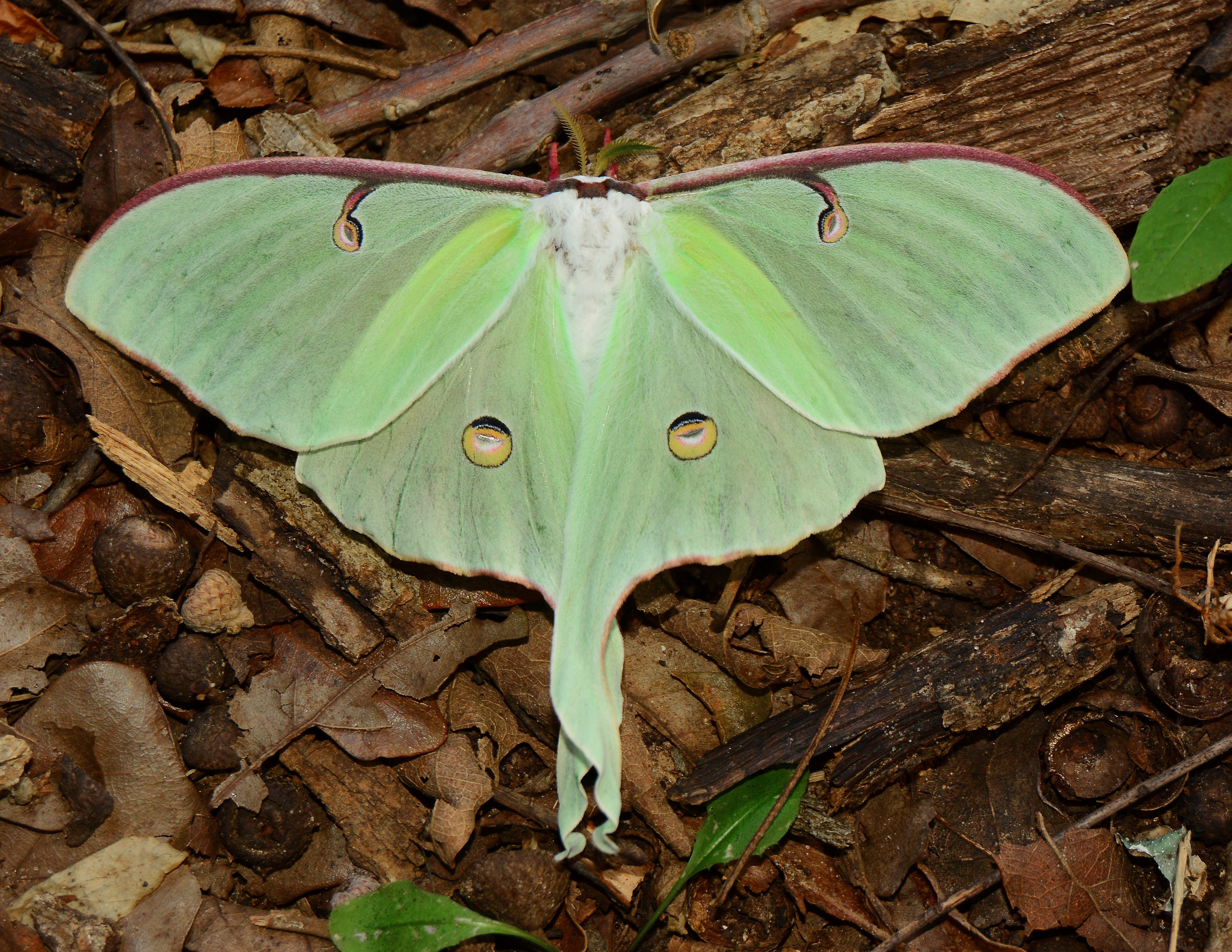
The moon moth
This week’s featured creature is a majestic night dweller of the forest with a fleeting adult lifespan.
Actias luna, the luna moth, is one of the most visually stunning moths in North America. It more resembles a butterfly than a moth and it is only found in North America.
As a child and into my teen years, I had plans to have a career as some sort of “-ologist.” I changed my mind frequently on just which branch of zoology I planned to specialize in. First, I wanted to be a herpetologist, then an ornithologist, then a mammologist, etc.
In the end, I became a writer. No one who ever saw me sleep during English classes would’ve ever guessed!
But one of the fields I studied — as much as a 10-year-old can — was entomology, the branch of zoology that concerns insects. I was fascinated by them. And the luna moth was an insect I had seen in photos and read about in books.
I was looking forward to seeing one, which I eventually did. The first time I saw one was the way most people see them — at a porchlight.
It was both exciting and slightly disappointing. I wanted to see one flying through its natural habitat — the woods. But I was still thankful that I finally saw one. A couple of years later, my wish was granted while I was hiking after dark under a full moon. One flew by me through a field as it went from one patch of woods to another. It was quite special.
I always love seeing luna moths, but there is also a certain sadness. Luna moths do not have mouths or digestive systems, as their only purpose is to mate. So, once they sprout their wings, they do not live long.
Appearance
The luna moth can have a wingspan of three to four-and-a-half inches. Its wings are pale green overall. Its forewings have reddish or purple front margins. It has spots which resemble eyes on each of its forewings and hindwings.
Its body is white overall, and it has reddish legs and a brown and beige colored face.
But what makes the luna moth really stand out are the two tails which stem from its hindwings. The tails add to its beauty and uniqueness.
But these tails are not just decorative, they serve a lifesaving purpose.
Lunas, like many moths, are subject to predation from owls and bats. In 2014, the Proceedings of the National Academy of Sciences of the United States of America discovered that luna moths use their tails to thwart bat attacks.
“Using high-speed infrared videography, we show that the spinning hindwing tails of luna moths lure echolocating bat attacks to these nonessential appendages in over half of bat–moth interactions,” the PNAS website states. “Further, we show that long hindwing tails have independently evolved multiple times in saturniid moths. This finding expands our knowledge of antipredator deflection strategies, the limitations of bat sonar and the extent of a longstanding evolutionary arms race.”
In other words, the bats will often strike the tails and miss the essential wings and body.
Scientists believe luna moths’ tails play a minimal role in flight performance.
To attain this knowledge, the PNAS conducted tests using moths that had tails intact, and moths which tails were removed.
The PNAS reports that bats captured 81.3% of moths without tails, versus only 34.5% of tailed luna moths.
They deduced that a moth without tails is 8.7 times more likely to be captured than a moth with tails.
To me, that’s fascinating! Also, there was a lot more information in these tests, but I don’t want to put you to sleep, so I’ve left out the nuts and bolts. To learn more, visit www.pnas.org/content/112/9/2812. It’s good stuff!
Range
The luna moth is found in the deciduous forests of eastern North America, including most of Oklahoma, where host trees are found.
Life stages
The luna moth goes through four stages of life: the egg, the caterpillar, the pupa and the adult.
A female can lay up to 600 eggs, a half dozen or so under a leaf at a time. The further south in their range, the more generations can occur each year. In this area, the luna moth flies from early April into August. There can be three generations of moths produced as Oklahoma has a warm climate.
When caterpillars emerge from the egg, they have a voracious appetite and eat constantly, according to National Geographic. Luna moth caterpillars eat the leaves of many trees, including hickory, walnut, sycamore, sweet gum, birch, walnut, etc.
Luna moth caterpillars, like all moth and butterfly caterpillars, go through five stages before cocooning. Scientists call these stages instars.
Each instar takes about five days, and at the end of each instar, the caterpillar will molt, shedding its old skin.
Once it reaches the third instar, the luna moth caterpillar is lime green with a gel-like appearance — like a gummy bear. They have little dots along the body, which are usually orange and red.
Just prior to pupation, the caterpillar will turn a reddish color.
Once it’s time, the caterpillar will then create a cocoon around itself using silk and often a leaf. It will live inside the cocoon for about three weeks, then emerge as a moth. Once it frees itself, from the cocoon, the luna moth will spend some time filling its wings with fluid, then use the rest of the day to dry.
Once it’s ready to fly, the moth will then search for a mate. That is all it will do before it dies.
Odds and ends
• In 1987, the United States Post Office issued a first class stamp with the image of the luna moth.
• The luna moth became quite recognizable when, a few years back, its image was used as a spokesmodel by a popular sleeping medication.
Editor’s Note: Randy Mitchell is a freelance writer and photographer. He has been an avid birdwatcher, nature enthusiast and photographer for more than 40 years. Reach him at rnw@usa.com.