

This week, I had planned to feature a little warbler that inhabits the Comanche County area.
However, time may be of the essence when it comes to featuring this week’s subject, the limpkin. And while this bird may have never visited southwest Oklahoma, it might do so in the future.
Limpkin sightings are all the rage in Oklahoma and Texas right now, so this is probably a good time to feature it. The fact that this species is being seen at all in Oklahoma and Texas is the reason behind the bird’s current popularity.
The limpkin's range includes a large portion of South America, portions of Central America, southern Mexico, the Caribbean Islands, and, historically, only in Florida in the United States.
However, it seems in the last few years that sightings of this bird have been occurring further and further west. Now, these sightings are isolated, and I don’t know for certain if there are any nesting pairs outside of Florida, but it is fascinating, nonetheless.
There has been one inhabiting Red Slough Wildlife Management Area in southeast Oklahoma for quite some time now, then there is one at Oxley Nature Center in Tulsa.
Also, a limpkin has been hanging out in a creek in Lewisville, Texas, for at least a week. And as far as I know, that is the furthest west in the United States that one of these birds has been seen.
Lewisville is about a two-and-a-half to three-hour drive from Lawton, depending on the route. But considering a few years ago one would need to drive to Florida to see one, 170 miles or so isn't too bad.
On Monday, my son and I journeyed to Lewisville to look for the bird.
It didn’t take very long for my us to find it. It had first been seen in Timber Creek on the north side of Hebron Parkway, and that's exactly where we found it.
I had wanted to see a limpkin for nearly my entire life and thought I would have to travel to Florida to see one, so a drive to Lewisville was a short trip, all things considered.
After I made a social media post to a birding site about observing the bird and its behavior, and how happy I was to see one without having to travel 1,200 miles to see one, a person commented, "Glad you did as they aren’t always easy to find in Florida either."
But before traveling to one of the places where these birds are being seen, I suggest checking for the latest reports on eBird.
The last report I saw for Oxley Nature Center, the bird was seen on Tuesday, but a person said he had a hard time locating the bird due to flooding.
That’s another thing, because these birds prefer shallow water, recent rains could have them moving around.
The last reports at Red Slough and Lewisville were also Tuesday, but again, recent rains could change things.
And when I say “last reports,” those are the last reports I saw before submitting this column Wednesday morning. Also, anyone interested in bird sightings should join Facebook groups such as Oklahoma Ornithological Society, Oklahoma Bird Watchers, North Central Texas Bird Alert, Birds of Texas, etc.
Appearance
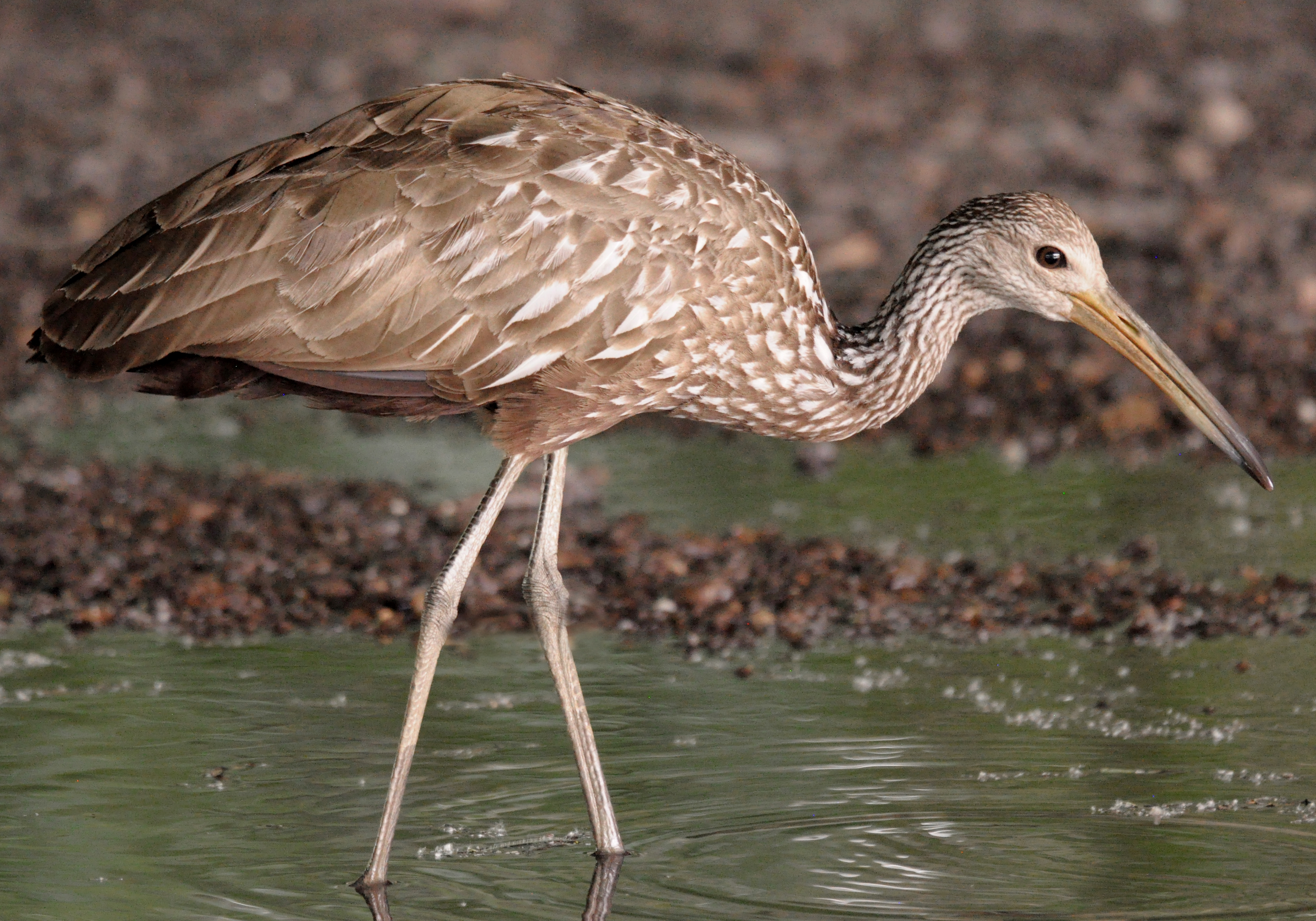
The long-legged limpkin is ibis-sized, and it is also shaped somewhat like an ibis with a rail’s bill (photo).
It ranges in length from 25 to 30 inches. I’m not certain of the height, but the bird I saw stood about two-and-a-half to three-feet tall.
While observing the bird in Lewisville, as it walked along, its body shape and feeding style reminded me of a crane. And no wonder. The Cornell Lab of Ornithology reports that although limpkins somewhat resemble herons and ibises, they are more closely related to rails and cranes.
It is brown in color overall, with white spots and streaks on the top and sides (photo). Male and female look alike.
Its yellowish bill is long and heavy with a strange little twist at the tip. The twisted shape allows the bird to expertly remove the insides of freshwater mollusks.
Diet
The Cornell Lab of Ornithology reports that limpkins feed almost exclusively on apple snails, an invasive species, but also on “at least three other native freshwater snail species and five species of freshwater mussels.”
In the few hours I observed the limpkin in Lewisville, it fed almost exclusively on what I believe was corbicula fluminea (Asian clams). It seemed to pull one out of the water every minute or two.
It used its twisted bill to pry open the clams and remove and consume the insides with relative ease.
They also eat small amounts of seeds, insects, crayfish, reptiles and amphibians.
Habitat
Limpkins can be found in shallow fresh water, including marshes, creeks, ponds, lakes and sloughs.
Odds and ends
The United States Geological Survey reports that the limpkins favorite food, the apple snail, is native to South America and was likely introduced to the southeast United States by way of the aquarium trade. The USGS reports that certain species are established in Florida, Georgia, Texas and Louisiana. Researchers are concerned as the snails have the potential to negatively impact wetland and aquatic ecosystems, agricultural crops and human health as they can carry parasites.
Editor’s Note: Randy Mitchell is a freelance writer and photographer. He has been an avid birdwatcher, nature enthusiast and photographer for more than 40 years. Reach him at rnw@usa.com.