

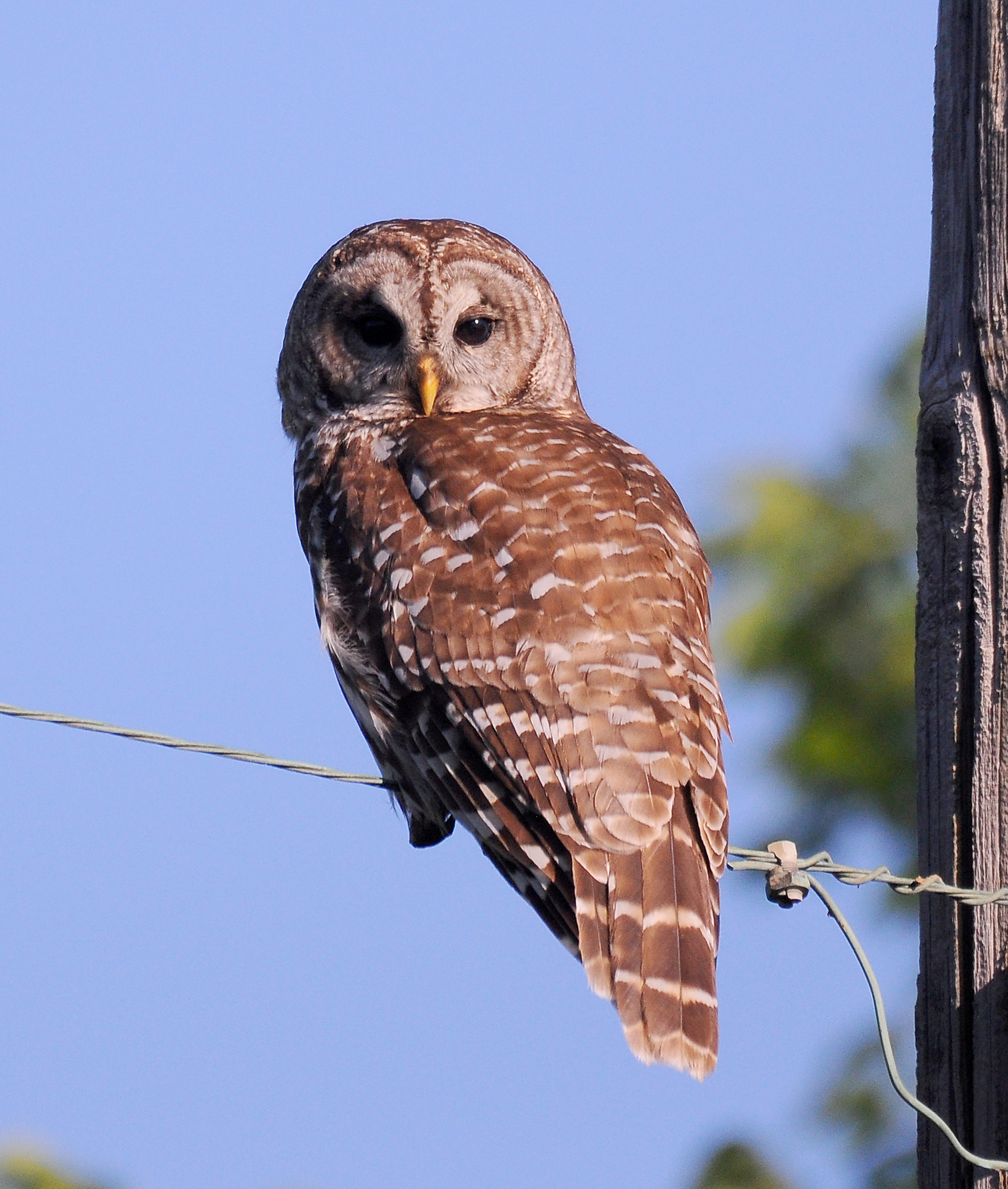
The laughing owl
The barred owl may just be my favorite bird.
I have a fondness for nearly all birds, but I have a long, interesting history with barred owls.
When I was a kid, I learned to mimic owl calls by cupping my hands together and blowing into them at the thumbs. With that, I could attract great horned, screech and especially, barred owls.
The melodic hooting of barred owls is often described as, “Who cooks for you, who cooks for you all?” Barred owls are called laughing owls as they have an ability to make loud cawing and caterwauling sounds. When a group gets the “laughter” going, it can sound frightening to someone who is unfamiliar with the bird.
On one occasion, while I was camping with my family as a child, I made several owl calls while we were in a tent. In the darkness of a moonless night, and long after I stopped, a barred owl sounded off. I looked out of the tent and pointed a flashlight into the trees above us. To my amazement, there were more than a dozen barred owls in a large oak directly above us. It was an amazing sight. I stayed in the tent and made some more calls, and, within a minute or so, they all started hooting and chiming in with the laughing sounds.
Some years later, when my family lived on a farm in a house next to the woods, I would call up many, many owls. There would sometimes be 20 or more outside making their wicked sounds. When packs of coyotes would sound off at the same time, it sounded like the end of the world. But I, a city kid, thoroughly enjoyed it.
When more than a few of these birds get going with the echoing laughter, the woods can sound like some sort of asylum of evil.
However, as scary as they sound, they are fairly docile birds, and they seem so gentle, unless you're a food item, of course.
In fact, the Cornell Lab of Ornithology reports that the barred owl, only a little smaller than the great horned owl, is “markedly less aggressive,” and “competition with its tough cousin may keep the barred out of more open woods.”
Appearance
Barred owls are medium-sized -- as far as owls go -- at 18 to 24 inches in length.
They have round heads, with large, dark, soulful eyes upon a well-defined facial disc. Barred owls are a mixture of brown, gray and white, with vertical brown streaks on their bellies and lower breasts. They are named for the horizontal brown bars on the upper necks and upper chests.
Range
Range includes woodlands of the eastern half of the United States, as well as many forested areas of Canada and portions of the American Northwest. Barred owls can be found over most of Oklahoma, but are more common in the eastern half of the state. In Comanche County and the surrounding area, look for these owls in more wooded areas.
Habitat
Heavily wooded areas, especially near water.
Diet
Mostly small rodents such as rats and mice. However, barred owls also eat other birds, insects, reptiles and amphibians. And I’ve seen trail camera footage on YouTube which showed barred owls landing in shallow water to grab up frogs and crayfish. Quite interesting.
According to the Cornell Lab, barred owls have sharp eyes and ears and hunt by sitting and waiting on an elevated perch.
Other mammals taken include squirrels, chipmunks, rabbits and shrews.
Nesting
According to the Cornell Lab of Ornithology, barred owls most often nest in a natural cavity, 20 to 40 feet high in a large tree. Stick platform nests built by other animals (including hawks, crows, ravens and squirrels) are sometimes used as well.
Barred owls will also nest in manmade boxes which are placed properly in wooded areas. For more information on building nest boxes, visit https://nestwatch.org/ and search for a bird of interest.
However, barred owls may prospect a nest site as early as a year before using it, so placing a nest box out well before breeding season is strongly encouraged.
Females lay one to five eggs which are incubated for about one month, according to the Cornell Lab. Nestling period is four to five weeks.
Odds and ends
- The Cornell Lab reports that the great horned owl is the most serious predatory threat to the barred owl. And, although they often live in the same areas, a barred owl will move to another part of its territory when a great horned owl is nearby.
- The Cornell Lab also reports that the oldest known barred owl was at least 24 years old.
(Editor’s Note: Randy Mitchell is a freelance writer and photographer. He has been an avid birdwatcher, nature enthusiast and photographer for more than 40 years. Reach him at rnw@usa.com.)