

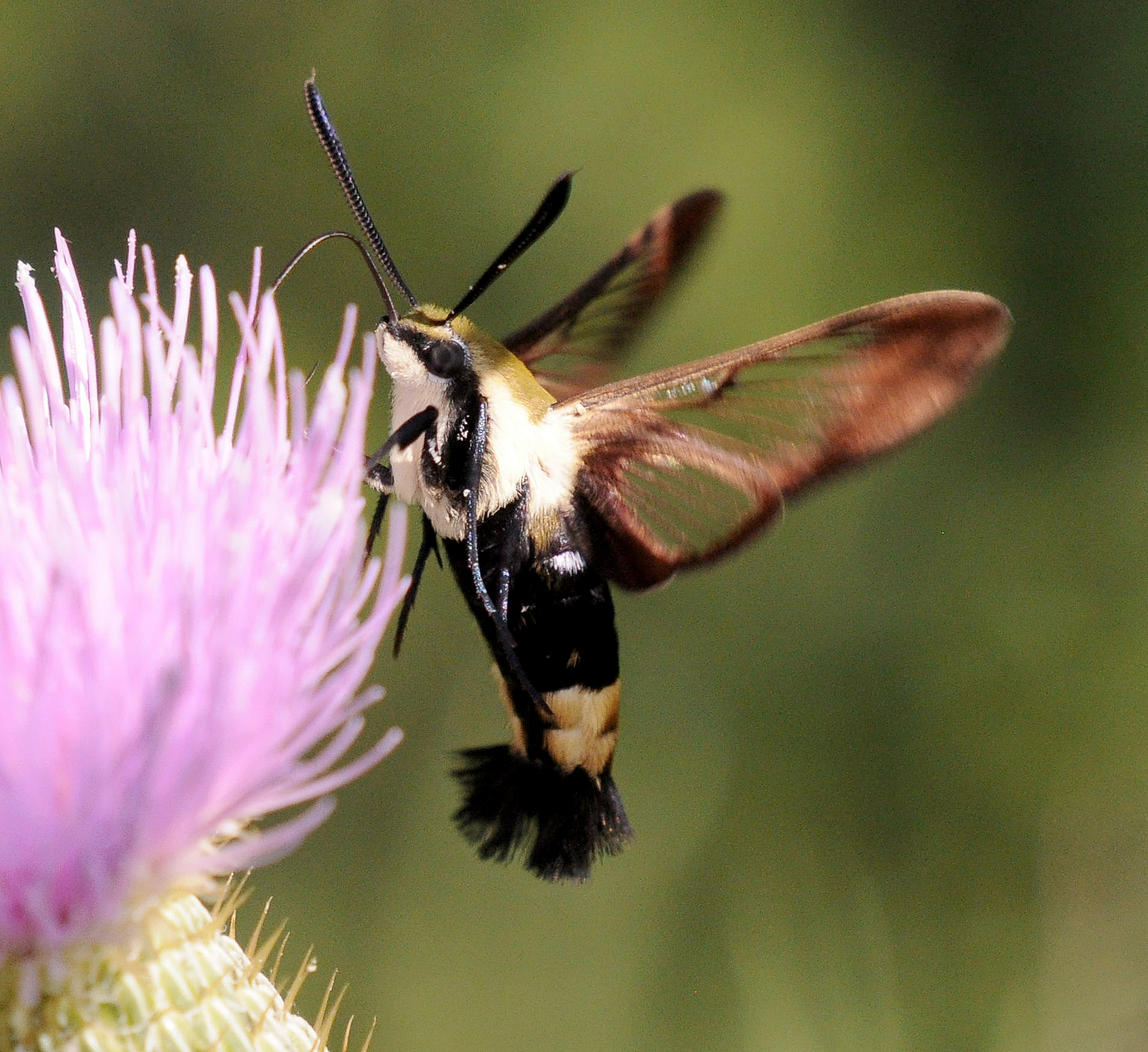
Fly like a hummingbird, look like a bee
This week’s featured creature flies like a hummingbird and looks like a bumblebee.
However, the snowberry clearwing is not a bird nor a bee. It isn’t a butterfly, either. And it cannot sting.
It is a moth. A sphinx moth, to be precise.
Now, I was recently tagged in a social media post concerning a photo of a hummingbird clearwing, and the author of the post had correctly identified it as such.
A friend tagged me in the post and asked if I knew about them, and wondered if I was planning to feature the species in a future column.
I responded, “Yep, snowberry clearwing” -- agreeing with the author’s identification -- but I mistakenly wrote snowberry, not hummingbird. Ugh!
I will feature the hummingbird clearwing in a future column, but I want to feature the snowberry clearwing first.
On a similar note, another species, the white-lined sphinx moth, has been quite abundant this year so far. I will feature in in a future column as well.
Appearance
At 1-1/4 to 1-3/4 inches in length, the snowberry clearwing moth is about half the size of a ruby-throated hummingbird.
An adult snowberry clearwing has large eyes on a protruding head, along with a single black stripe on each side of its furry thorax (photo). Its conical abdomen extends well beyond the hindwings when the moth is in flight (photo).
The coloration resembles that of a bumblebee: the body is a mixture of fuzzy golden yellow and black (photo).
Wings are clear with dark veins. Legs are black.
The hummingbird clearwing has a reddish stripe across its back abdomen, and usually has more reddish veins on its clear wings. Its legs are pale or reddish-colored versus the snowberry’s black legs, and the underside is often white as well.
To get really technical, the snowberry clearing has a clear discal cell on the front of each wing (photo), while the hummingbird clearwing has split cells.
Larvae (caterpillars) are usually green with black spots around the spiracles and have a black "horn" with a yellow base on the back end.
Diet
Adult moths hover while feeding from a huge variety of flowers. According to the Missouri Department of Conservation, snowberry larvae feed on buckbrush (coralberry), snowberry, horse gentian, blue star, honeysuckles and dogbanes.
Range
The eastern half of the United States and Canada, eh, from the Great Plains States and east.
Life cycle
Adults fly from late March well into September.
(Editor’s Note: Randy Mitchell is a freelance writer and photographer. He has been an avid birdwatcher, nature enthusiast and photographer for more than 40 years. Reach him at rnw@usa.com.)